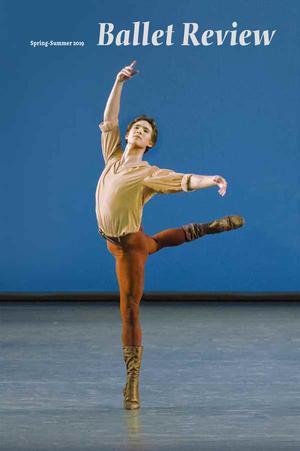
Ballet Review 47.1-2
Spring-Summer 2019
| Coming in the next issue…
The Metropolitan Balanchine
by Marian Smith
It was Kirstein who, starting in 1934, pushed for Balanchine’s hiring at the Met… Kirstein’s plan was to create ballets for opera,…but to devote the choreographer’s main efforts toward making new, stand-alone ballets… A strict requirement for Kirstein was that the repertory include ballets on American subjects – for instance, “New England in Colonial times, pre-Civil War days, early Dutch life in Pennsylvania, and the West during its stirring pioneer days.”
If Balanchine had an explicit notion of what constituted American ballet,…he did not disclose it… In a Daily Mirror story called “A Real American Ballet for the ‘Met’” [he did say], “The American girl makes the ideal dancer because she is better built than girls of other countries. This, I think, is due to the freedom permitted American women and the frequency…with which they engage in athletics from young girlhood.”
But Balanchine’s ideal “American girl” may not necessarily have been what white audiences in America would have expected. In Paris, before ever coming to America, Balanchine had encountered one of the most accomplished and famous American dancers of the day… As the dance historian Beth Genné…posits…Balanchine had found in Josephine Baker his first American muse in a long line of long-legged, lithe female dancers… And it was not only American women whom Balanchine admired; he is also known to have found great inspiration in Fred Astaire… In short, one may surmise that for Balanchine in 1935, if there were such a thing as American ballet, it relied on the American body and its ways of moving, not – as Kirstein held at the time – on American subjects, themes and music.
|